DevOps, Quantum Cognition, and the Power of Narratives: From Firefighting to Flow
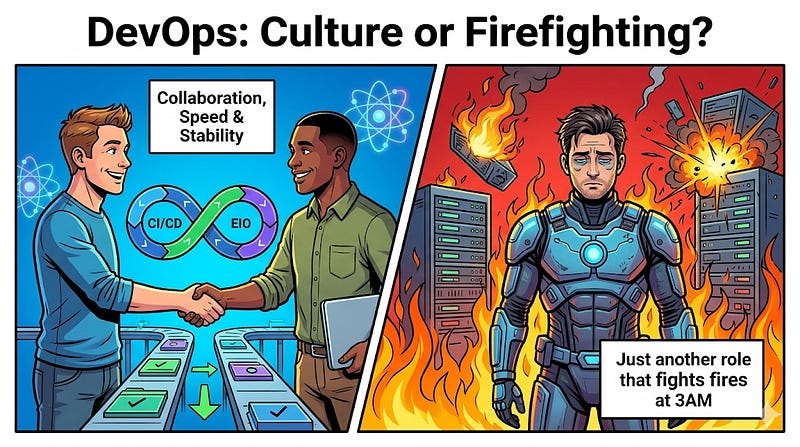
With a deep curiosity about the universe, I often find myself tracing unexpected connections across disciplines. The spark for this particular exploration came while reading Heinz Pagels’ classic The Cosmic Code — a beautifully lucid book that explores the profound implications of quantum mechanics without descending into mysticism.
Pagels masterfully explains how quantum theory overturned the classical worldview. At the subatomic level, reality exists in a state of potential — superpositions of possibilities — until an observation or measurement collapses it into a definite outcome. The “observer” plays a fundamental role, not necessarily through consciousness in the mystical sense, but through interaction and context. This idea of observer-created reality (or more precisely, measurement-dependent reality) stayed with me.
At the same time, I was reflecting on countless conversations about DevOps transformations. I kept seeing a recurring pattern: organizations that treated DevOps as just another role or set of tools often ended up with more chaos, more firefighting, and deeper silos. Those that embraced it as a true culture — collaboration, shared ownership, automation, and continuous learning — experienced dramatically different outcomes: more predictable systems, faster delivery, and calmer lives for engineers.
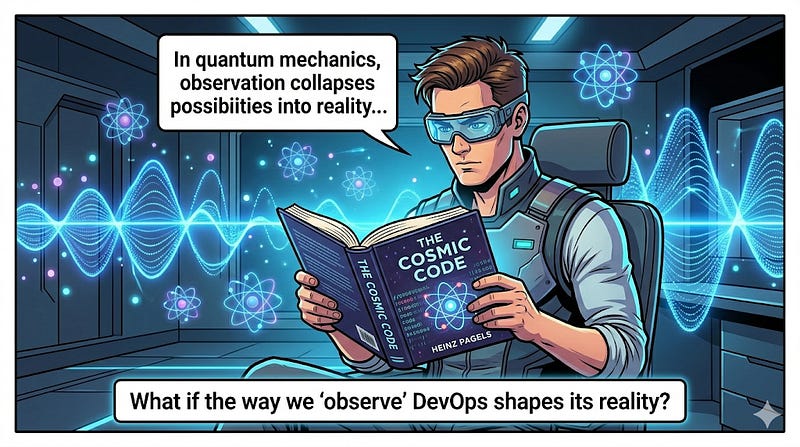
The parallel struck me powerfully.
In quantum mechanics, how you observe and interact with a system determines what reality emerges. In organizations, how teams perceive and frame DevOps (as a role versus a culture) literally collapses their operational reality into either reactive firefighting or proactive flow. Negative narratives and antipatterns act like poor measurement contexts that lock teams into undesired states. Strong collaborative practices, on the other hand, create the right kind of “decoherence” — turning messy potential into stable, deterministic, and reliable outcomes. This isn’t quantum mysticism. It’s using conceptual tools from quantum cognition and physics as powerful metaphors to illuminate human and organizational behavior. Just as Pagels showed how quantum ideas reshape our understanding of the cosmos, these ideas can reshape how we think about building and operating complex software systems. What began as an intellectual curiosity — connecting observer effects and narrative psychology to DevOps antipatterns — became a useful framework for explaining why some transformations succeed while others stagnate.
This preface sets the stage for the blog that follows. My hope is that it offers not just technical insight, but a fresh perspective on why culture isn’t a “soft” concern in DevOps — it is the very mechanism that determines the reality your teams and systems will inhabit.
In the world of software delivery, DevOps promised a revolution — a cultural shift that would break down silos, accelerate delivery, and create resilient systems. Yet for many organizations, it has devolved into a firefighting role: a dedicated team (or person) that handles production incidents, manages brittle infrastructure, and absorbs the friction between Development and Operations.
Why does this happen? And how can we reclaim the original vision? Surprisingly, insights from quantum cognition and cognitive psychology offer a powerful lens to understand — and fix — this transformation.
The Negative Narrative Trap
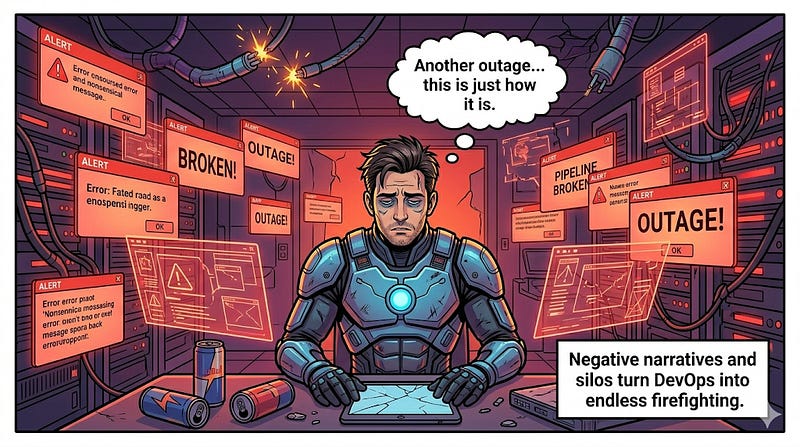
Cognitive psychology shows humans suffer from a strong negativity bias: we pay more attention to threats, remember failures longer, and interpret ambiguity through a pessimistic lens. When repeated, these form self-reinforcing negative narratives that shape our perceived (and actual) reality.
In DevOps, the dominant narrative became:
“DevOps is the team/role that owns production and stays on-call to fix things when they break.”
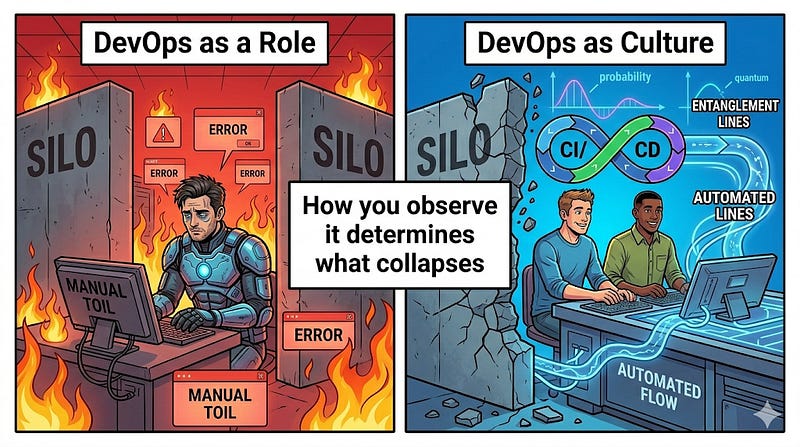
This interpretation bias turns every flaky deployment, production blip, or infrastructure quirk into confirmation of the story. Teams ruminate on outages rather than learning from them. Successes (smooth releases, reduced toil) are under-celebrated. The result? A reactive culture of heroics, burnout, and persistent silos — despite the “DevOps” label.
This is the psychological equivalent of a measurement collapsing a quantum system into an undesired state. The narrative doesn’t just describe the problem — it creates it.
Quantum Cognition: A Better Model for DevOps Behavior
Quantum cognition applies the mathematics of quantum probability to human decision-making and judgment. It doesn’t claim the brain is quantum; it simply shows that classical probability often fails to capture real human behavior. Concepts like superposition, contextuality, interference, and entanglement model phenomena such as order effects, ambiguity, and non-commutative thinking far better than traditional models.
Apply this to DevOps:
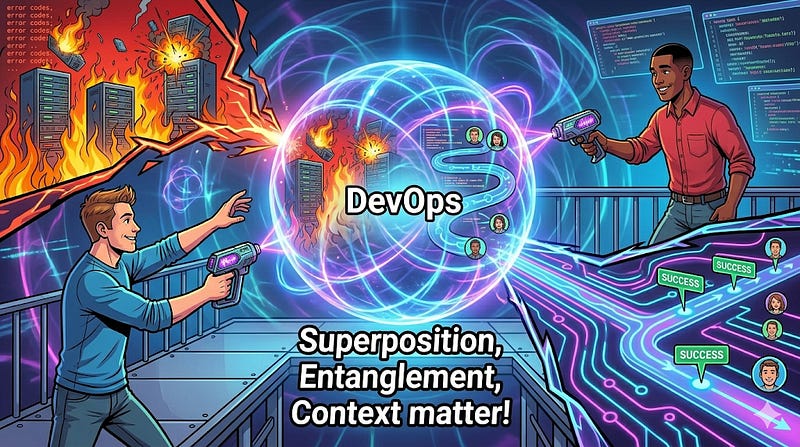
Superposition: A healthy DevOps practice holds multiple desirable states simultaneously — velocity and stability, autonomy and accountability, rapid experimentation and reliability. When treated merely as a role with traditional silos intact, this superposition collapses prematurely into a single bad outcome: “Ops = perpetual firefighting.”
Context and Order Effects: The sequence and framing of how you approach DevOps matters enormously. Asking “Who owns this alert?” first reinforces silos and blame. Starting with “How do we make this observable, automatable, and jointly owned?” creates constructive interference toward better outcomes.
Entanglement: True DevOps creates deep correlations between Development and Operations. A change in one team’s practices instantly affects the other through shared ownership, metrics, and feedback loops. Siloed implementations break this entanglement, leading to disconnected, brittle systems.
Decoherence into Classical Predictability: In quantum mechanics, interaction with the environment turns fuzzy superpositions into stable, classical behavior. In DevOps, a strong collaborative culture acts as that environment. Automation, observability, blameless post-mortems, and shared responsibilities cause rapid “decoherence” away from chaotic firefighting toward deterministic, reliable outcomes.
Culture vs. Role: Collapsing the Wave Function Toward Better Reality
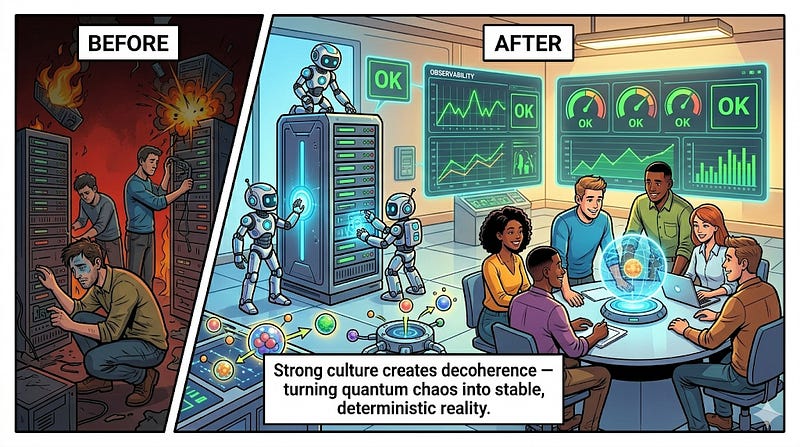
When DevOps remains a thin layer over unchanged silos, it reinforces the negative narrative. Infrastructure stays snowflake-like and unpredictable. Deployments remain risky. On-call rotations drain energy. Life for both developers (waiting on Ops) and operators (constant context-switching and toil) stays difficult.
By contrast, committing to DevOps as a culture — embodied in principles like CALMS (Culture, Automation, Lean, Measurement, Sharing) or the Three Ways (Flow, Feedback, Continual Learning) — fundamentally changes the system:
Automation and Infrastructure as Code make environments reproducible and version-controlled, turning previously non-deterministic behavior into reliable, auditable code.
Observability and Measurement shift focus from reactive alerts to proactive signals and error budgets, reducing ambiguity.
Collaboration and Psychological Safety counter negativity bias by emphasizing learning over blame. Shared responsibilities entangle teams productively.
Continuous Improvement treats toil and recurring issues as bugs to be eliminated, not facts of life.
The outcome is more deterministic systems. Failures become smaller, more contained, and faster to recover from. Deployments grow frequent and low-risk. Cognitive load decreases. Developers ship faster with confidence; operators engineer resilient platforms instead of babysitting them.
Practical Steps to Rewrite the DevOps Narrative
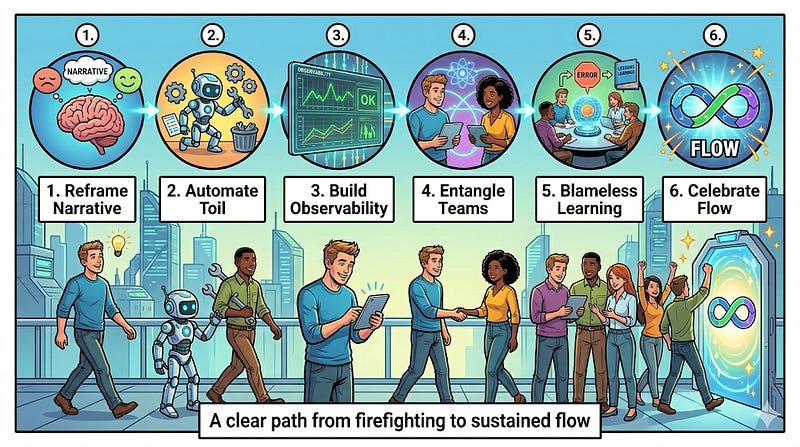
Audit and Reframe the Story: Actively surface and celebrate non-incident wins. Track and publicize metrics like deployment frequency, change failure rate, and toil reduction alongside MTTR.
Change the Order of Operations: Begin initiatives with cultural and joint ownership questions. Form cross-functional platform teams or inner-source models.
Entangle Teams Intentionally: Implement shared on-call (with proper support), pair programming across boundaries, and common tooling/platforms.
Automate Ruthlessly: Identify and eliminate manual toil. Treat every repeated incident as a prompt for automation or architectural improvement.
Build Observability First: Make systems transparent by default. Good observability turns ambiguous failures into clear, actionable insights.
Foster Blameless Learning: Use blameless post-mortems and chaos engineering to explore edge cases safely, building antifragility.
Conclusion: Narratives Shape Technical Reality
DevOps was never meant to be another silo or a hero role — it was intended as a cultural transformation that aligns incentives, accelerates feedback, and builds resilient systems. The antipatterns that turned it into firefighting are largely perceptual and cultural, reinforced by cognitive biases we all share.
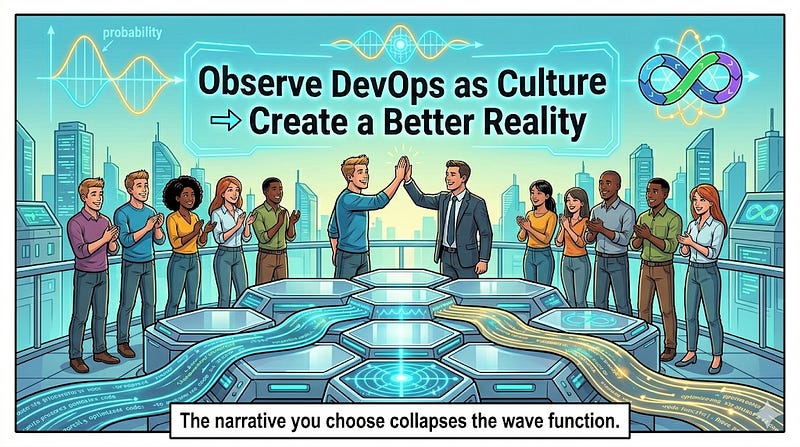
By understanding DevOps through the lens of quantum cognition — superposition of possibilities, contextual collapse, and entanglement — we see that the outcome depends heavily on how we observe and interact with our organizations and systems. Shift the narrative, commit to the culture, and the wave function collapses toward a better reality: more deterministic infrastructure, smoother software delivery, and significantly better lives for developers and operators alike.
The tools and principles already exist. The question is whether we’ll let the negative story persist — or actively build the collaborative culture that makes DevOps deliver on its original promise.